Computational proteomics and signaling
We model proteomic, phosphoproteomic, cytokine, and secretome data to infer pathway activity, regulatory structure, and disease-relevant molecular states.
National Technical University of Athens
Engineering, computation, and molecular measurement for translational biology and medicine.

BioSysLab develops measurement and computational frameworks for translational biology. The lab's core expertise is mathematical, computational, and data-driven modeling, integrating molecular measurements and clinical context with biomedical questions in cancer, chronic disease, drug response, and precision health.
Research
We study biological systems through mathematical models, machine learning & AI, network biology, and computational analysis of high-dimensional biomedical data. Wet-lab access and experimental/clinical collaborators support.
We model proteomic, phosphoproteomic, cytokine, and secretome data to infer pathway activity, regulatory structure, and disease-relevant molecular states.
We combine plasma proteins, liquid-biopsy signals, clinical variables, and causal evidence into interpretable models for early detection, monitoring, and stratification.
We develop interpretable and generative models of disease trajectories, tumor resistance, drug response, and adaptive biomedical decision-making.
We use dynamical and stochastic models, optimal transport, and observability theory to study disease progression and what tissue and blood measurements can reveal about hidden biological states.
People

Professor, National Technical University of Athens
Prof. Alexopoulos leads BioSysLab at NTUA. He works at the interface of engineering, computation, proteomics, and medicine, with more than two decades of experience in multiplex assays and systems biology.
He has trained at Duke, MIT, and Harvard, co-founded the biotech spin-off Protavio, and co-founded the NTUA Master's program in Translational Engineering in Health and Medicine.

Research Associate
(June 08, 2026-present)
Nikolaos develops mathematical and AI methods to study how biological states change with disease and treatment. His interests span machine and deep learning, network biology, omics translation, disease trajectories, cross-compartment observability, and translational oncology, including tumor progression and treatment resistance.
He earned his PhD in Biological Engineering at MIT, followed by a postdoctoral appointment there, after training in Mechanical Engineering at NTUA.

PhD Candidate
Konstantinos works on multi-modal representation learning for clinical prediction from incomplete patient data, with molecular blood profiles, and in particular high-dimensional plasma proteomics, as the core modality. His interests span ML and AI for blood proteomics, robust learning when patient data modalities are missing, and the development of open-source ML tools for biomedical research.
Before joining BioSysLab, he worked in industry as a Software Engineer in healthcare and biotechnology. He trained in Electrical and Computer Engineering at NTUA.

Graduate Research Assistant
Kyriaki holds an Integrated Master's degree in Mechanical Engineering from NTUA. With a keen interest in biomedical systems, she joined BioSysLab to learn more about computational systems biology.
Her research mainly focuses on computational systems modelling in colon cancer progression.
Chemical Engineering Student / Undergraduate Researcher
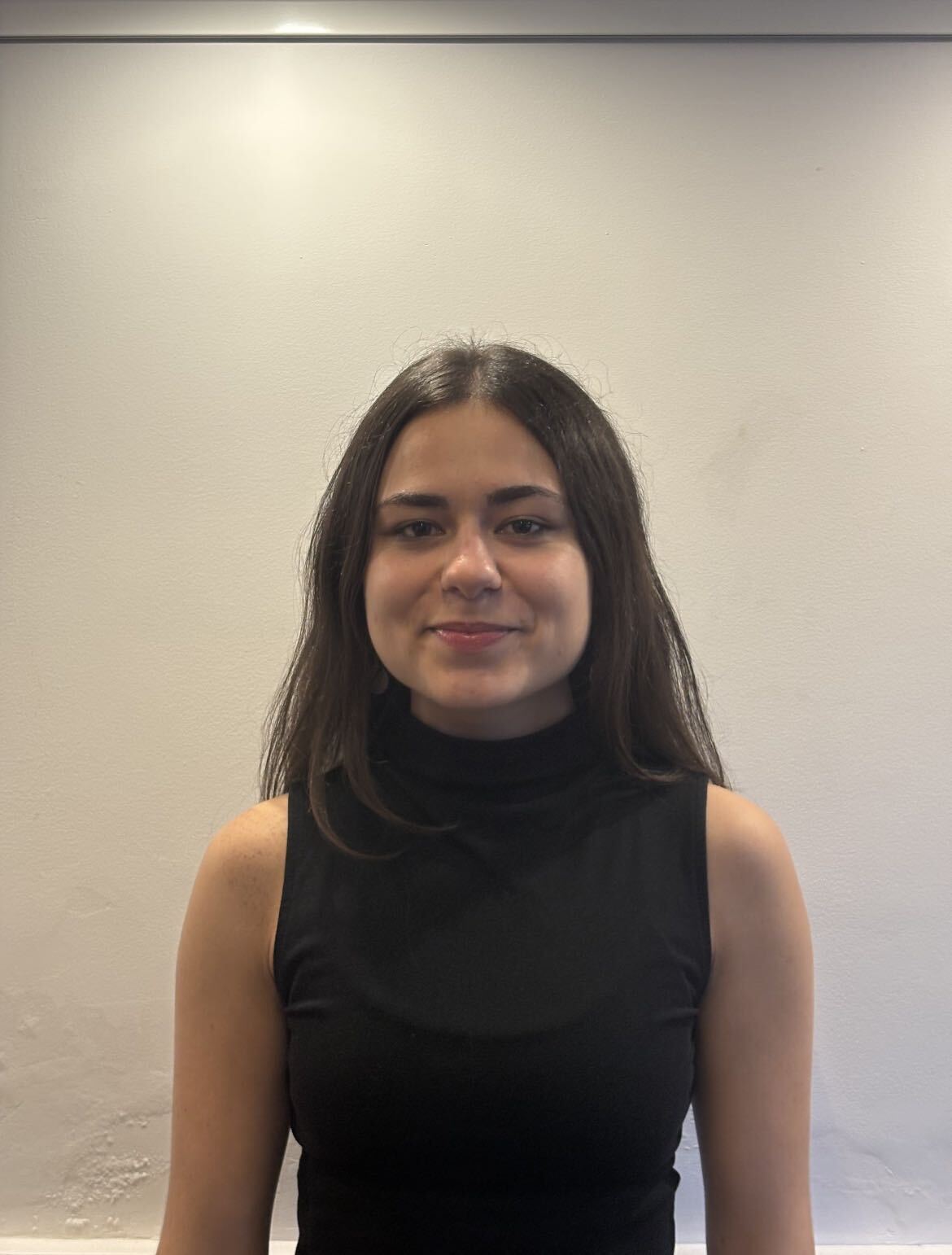
Anelajda (Lada) is beginning her fourth year in Chemical Engineering at NTUA. Her planned research asks which tumor signaling programs can be detected through blood proteins, using computational analysis of tissue and plasma measurements.
She will study how protein secretion, tissue specificity, and circulating abundance shape the signals that reach the blood.
Laboratory Manager
Polychronis supports BioSysLab's laboratory operations and research infrastructure. He has academic experience as a Scientific Associate / Assistant Professor at TEI of Athens and is currently affiliated with the School of Pedagogical and Technological Education.
Publications
Meimetis, Magliacane, Hoang, Lauffenburger. bioRxiv, 2026.
Cadavid, Meimetis, et al. Science Advances, 2026.
Kanelis, Nuesch, Snuggs, Le Maitre, Alexopoulos. JOR Spine, 2026.
Gali et al. iScience, 2024.
Meimetis, Lauffenburger, Nilsson. iScience, 2024.
Skea et al. Research Square preprint, 2023.
Proceedings of the 16th International Joint Conference on Biomedical Engineering Systems and Technologies, 2023.
Zareifi, Chaliotis, Chala, Meimetis et al. iScience, 2022.
Fotis, Meimetis, et al. & Alexopoulos. Molecular Omics, 2021.
Fotis, Alevizos, Meimetis, et al. & Alexopoulos. bioRxiv, 2021.
Courses
Teaching connects computation, biological engineering, biomedical technology, and design for health applications.
Also available in English for Erasmus students.
Also available in English for Erasmus students.
Also available in English for Erasmus students.
Vacancies
Open calls and informal inquiries will be posted here.
We welcome prospective students or collaborators with a strong fit in systems biology, computational biology, proteomics, or biomedical engineering to contact the lab with a concise research interest note and CV.
Contact
BioSysLab is located at the National Technical University of Athens, Zografou campus.
Tel: +30 210 7721666
Email: leo@mail.ntua.gr
Tel: +30 210 7721516